
Thoughts & Insights
Toke-ns, or how I spent my summer holiday

Toke Lund
CEO at Enterspeed

Most people came back from summer with a tan. I came back with three graphs.
My name is Toke. Add an “s” and you get the single most important unit in artificial intelligence. My parents did not plan this. But when your name is one letter away from the thing quietly draining every AI budget in Europe, you take it as a sign and cancel your other plans.
So I spent the summer looking at tokens.
Cost on the vertical axis. Context on the horizontal. The line goes up and to the right, which is normally the direction everyone wants, except in this case it's your invoice.
More context, more money. Everybody knows this. Everybody budgets for it. And then everybody quietly does nothing about it, because the alternative sounds like work.
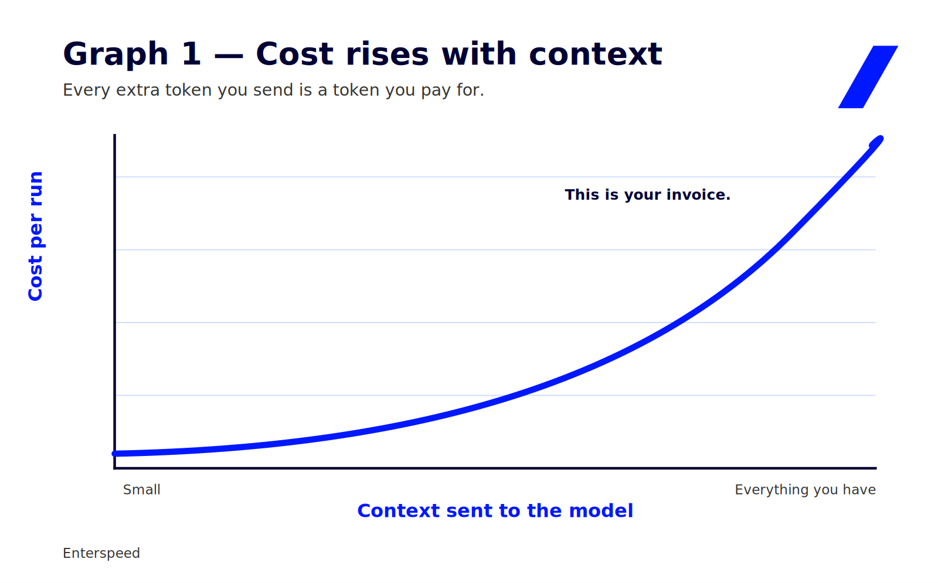 Figure 1 — Cost rises with context.
Same horizontal axis. Quality on the vertical. And the line goes down.
You pay more, and you get worse answers. It is, as far as I can tell, the only product on earth where the deluxe version is objectively less good than the standard one.
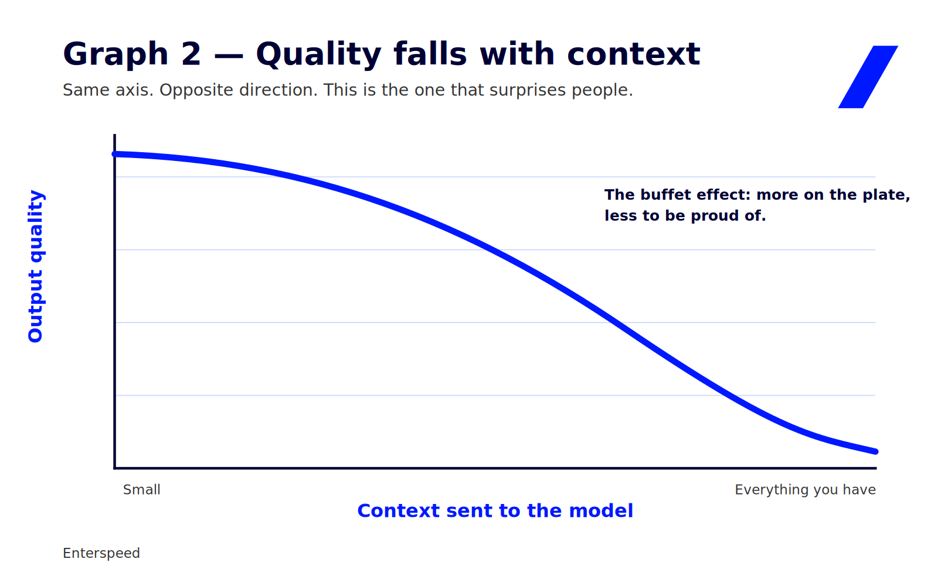 Figure 2 — Quality falls with context.
We've been treating context windows like a suitcase. If it fits, pack it. But a model with too much context behaves a bit like me at a hotel buffet — overwhelmed, indiscriminate, takes a little of everything, and afterwards nobody is proud of the results.
The model doesn't get smarter when you hand it more. It gets distracted. The signal you actually needed is now sitting somewhere in the middle of forty pages of things you sent along “just in case”.
Also read: 10 things about controlling AI and their hallucinations
I did an MBA. I am legally required to produce one of these per quarter.
Put context on one axis and task complexity on the other, and four corners appear.
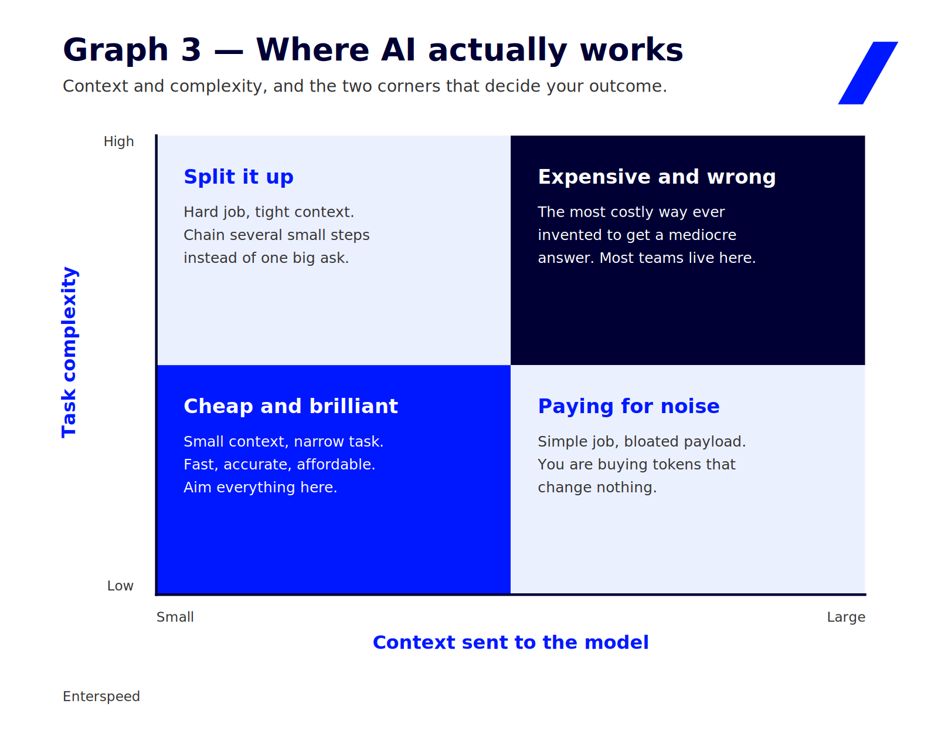 Figure 3 — Context and complexity.
Low context, low complexity. The model is fast, cheap and genuinely excellent. Nobody posts about this quadrant on LinkedIn because it isn't exciting. It's also where almost all the value is.
High context, high complexity. Expensive, slow, and confidently wrong. You have built the most costly method ever devised for obtaining a mediocre answer. This is also where most “AI strategies” currently live, whilst being described as ambition.
The other two corners are the ones worth being honest about. A simple job with a bloated payload is just paying for noise. A genuinely hard job with tight context isn't a failure — it's a signal that the job needs splitting into steps.
Three things, and they're all unglamorous.
Small context. Send what the question needs. Not what you happen to have. This is a data problem long before it's an AI problem.
Simple tasks. One narrow job per call. The moment you ask a model to be a strategist, a copywriter and a taxonomist simultaneously, quality drops in all three.
Precise data points. Every vague word is a token you paid for and got nothing back from. Structure beats volume every single time.
The practical move is to bundle your data into one tight, well-shaped payload, let the model do one clear job, take the answer, then chain the next step with the next slice of data. Yes, that's more calls. It is still dramatically cheaper, and the output is noticeably better.
The counterintuitive bit is that scale doesn't come from asking bigger questions. It comes from asking smaller ones, many times, very precisely.
Running AI across a handful of products is a demo. Running it across a full catalogue, in eleven markets, without the invoice or the quality falling over — that's the actual job.
That's what we've spent the summer building Enterspeed around. Getting data into exactly the right shape before it ever reaches a model. Not everything you own. Just what the question needs, structured so precisely that the model has nothing to be distracted by.
Also read: Ask your data anything: hands-on demo of the Enterspeed Query MCP
Turns out the answer to tokens was never more tokens.
Anyway. Nice summer. Would recommend the graphs over the tan.
CEO and Partner at Enterspeed. Speaker on digital transformation and the future of Enterprise tech. Loyal lover of Liverpool! ⚽❤️

© 2020 - 2026 Enterspeed A/S. All rights reserved.
Made with ❤️ and ☕ in Denmark.